
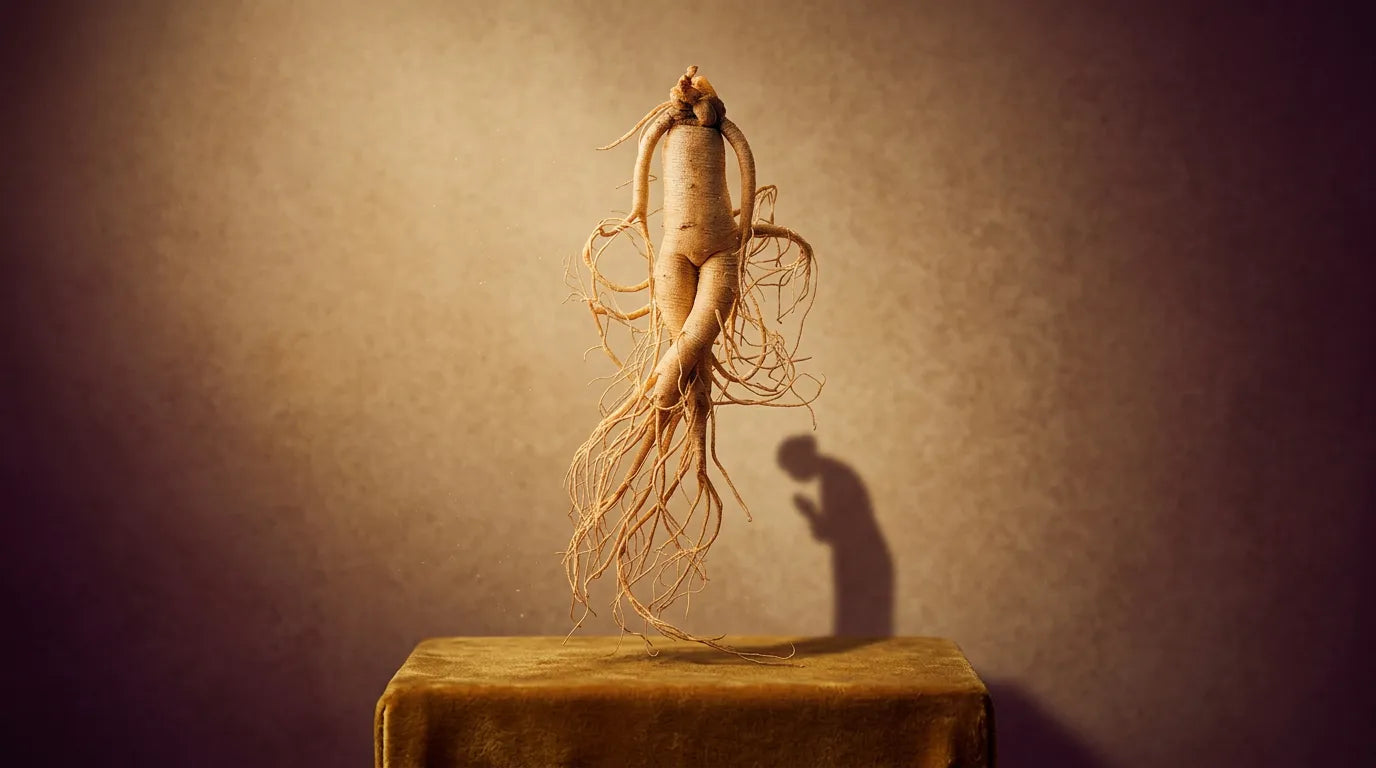

Its name literally means "person root." And on two continents, people who never met saw the same thing in it.
Ginseng is one of the few plants named after us. Look closely at a mature root, with its forked, limb-like shape, and you can see why. But the strangest part of the story is that cultures separated by an entire ocean, with no contact, looked at this root and arrived at almost the same idea about it.

The name is a clue
The English word "ginseng" comes from the Chinese rénshēn. Break it down and the meaning is striking: rén means "person," and shēn refers to this class of herb. Person-root. The Korean name carries the same idea. The reason is right there in the soil: a well-grown mature root, with a main body and two leg-like prongs, can look uncannily like a tiny human figure.
That resemblance wasn't a footnote. It was central to how the root was judged. In the traditional grading of fine ginseng, the most prized roots were the ones that most fully took on the human-like form, a connection we touched on in our piece on 6-year roots.
An old idea: like cures like
Why would a human shape matter so much? It ties into an old belief found in many traditional systems, sometimes called the "doctrine of signatures." The idea, held for centuries before modern science, was that a plant's appearance hinted at its purpose: walnuts resembling the brain, certain beans resembling kidneys, and a root shaped like a person surely meant to benefit a person.
To be clear, this was old folklore, a way of making sense of nature long ago, not a modern claim. But it explains the aura. A plant that looked human, growing slowly and secretly in deep forest shade, was always going to capture the imagination.
The part that gives you chills
Here's what makes the "person root" idea genuinely uncanny. The same recognition appeared on opposite sides of the planet, independently. In East Asia, the root was revered and named for its human form. Thousands of miles away, the Indigenous peoples of North America knew their own native ginseng and valued it too, long before any European connected the two.
Two worlds with no contact, looking at the same humble forked root, and both deciding it was something special. When a Jesuit missionary finally linked the Asian and American plants in the early 1700s, he wasn't introducing the root to anyone. He was just connecting two traditions that had, remarkably, arrived at the same place on their own.
"To ancient herbalists, a plant looking like a human must surely speak to the human. The root even carried the name to prove it."
The Ginseng Journal, on the man-rootA name worth living up to
You don't have to believe a single word of the old folklore to feel the pull of it. A root named after a person, prized for centuries across cultures that never met, grown patiently in forest soil. That's a heritage, not a marketing line. It's the kind of story that survives precisely because the thing at the center of it mattered so much to so many for so long.
Dr. Choi's roots come from Geumsan, one of the historic heartlands of Korean cultivation. We inherited the "person root," and we try to do its long name justice.
The root named after us
Dr. Choi's Korean Red Ginseng carries centuries of heritage forward: 6-year Geumsan roots, full spectrum, steamed the traditional way and lab-tested every batch.
Explore the ginseng →This article is a historical and cultural overview drawn from published histories and folklore and is for educational purposes only. References to traditional beliefs such as the doctrine of signatures are historical and are not statements of effectiveness. It is not medical advice and makes no health claims. These statements have not been evaluated by the Food and Drug Administration. This product is not intended to diagnose, treat, cure, or prevent any disease.