
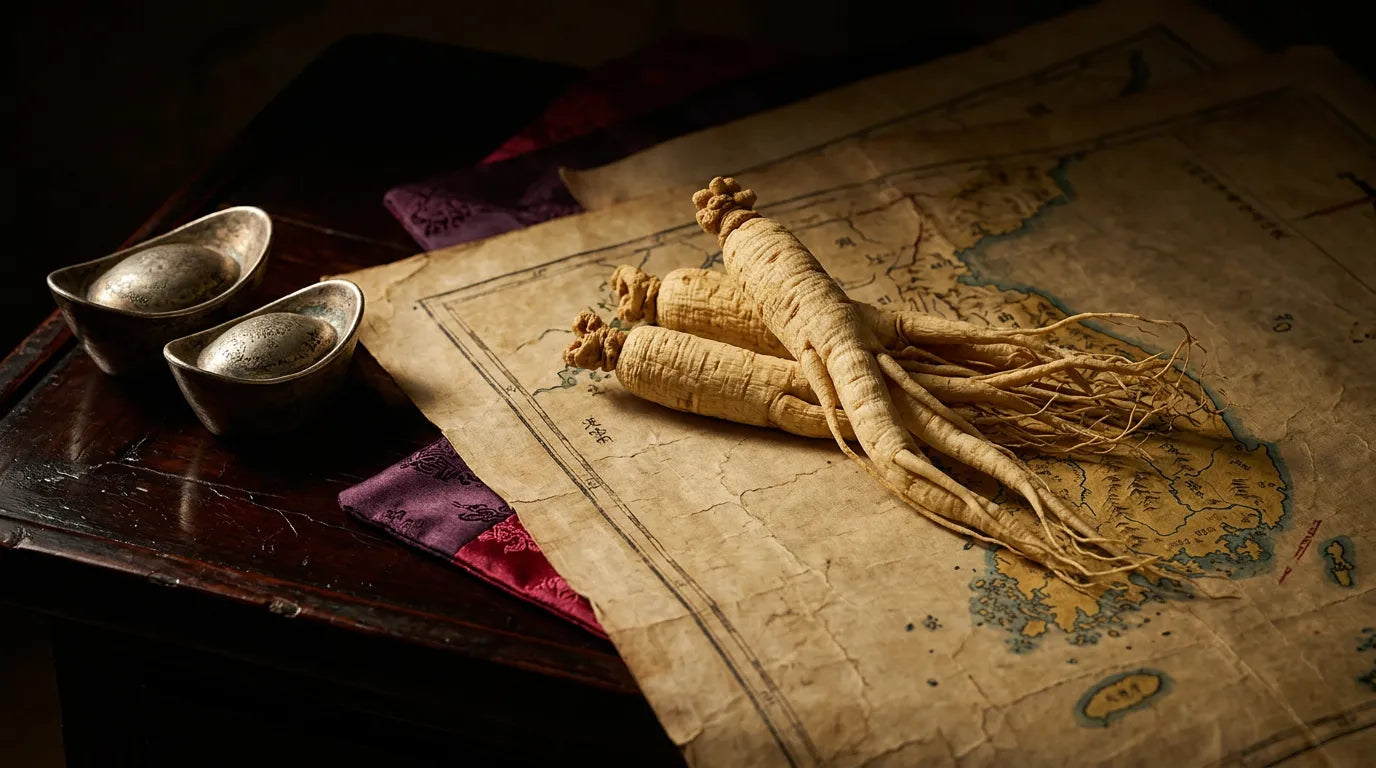

Empires have gone to great lengths over gold, spices, and silk. For a few centuries, one of the prizes was a root.
Long before ginseng was a wellness shelf-staple, it was a strategic asset, valuable enough to fund the rise of a dynasty, sealed off behind imperial borders, and woven into the tense relationship between two neighboring powers. This is the story of the root that helped shape a frontier.
One of the "Three Treasures"
In the borderlands of Manchuria, where wild ginseng grew in the forests, the root was counted among the region's famed "Three Treasures," alongside sable fur and pearls. These weren't curiosities. They were the wealth of the land, and ginseng was among the most valuable of the three.
The root that helped fund a dynasty
Here's the detail most people never hear. Before the Qing dynasty rose to rule all of China, its founder built his early power partly on ginseng. By establishing control over the trade in ginseng and sable, he is recorded as earning an enormous annual income, wealth that helped finance his military campaigns and his unification of the Jurchen tribes. A medicinal root, in other words, helped bankroll the birth of an empire.
A border drawn partly over a root
Because the best wild ginseng grew in the contested forests between Korea and Manchuria, the root became a recurring source of friction between the two courts. As the new dynasty consolidated power, it moved to claim the borderland ginseng for itself, restricting who could cross into the harvesting grounds and reshaping the flow of the trade.
Historians who study the period describe ginseng as a kind of microcosm of the larger relationship between the two states. Control of the root meant control of wealth, and over the seventeenth to nineteenth centuries, questions of who could gather it where became tangled up in the long negotiations that helped define the frontier itself.
"Conflict over ginseng can be seen as a microcosm of larger problems that affected Qing-Choson relations."
Seonmin Kim, Ginseng and BorderlandThe twist: scarcity made cultivation king
Then came the turn that changed everything. Centuries of intense harvesting thinned the wild ginseng of the borderland. Wild roots grew scarce on both sides. And scarcity, as it so often does, forced innovation.
Rather than depend on dwindling wild supplies, Korean growers leaned into cultivating ginseng deliberately, refining the methods that would eventually make Korean cultivated ginseng, and its processing into red ginseng, world-renowned. The contest over a wild root became, in the end, the seed of an agricultural tradition. The reputation Korea built around cultivated ginseng outlasted the borderland disputes entirely.
What survives the empires
Dynasties rose and fell. Borders shifted. But the knowledge of how to grow and process this root, painstakingly developed over generations, endured and matured. That's the quiet lesson of the whole saga: empires fought over wild ginseng, but the lasting prize went to those who learned to cultivate it well.
Dr. Choi's roots come from Geumsan, one of the historic heartlands of Korean cultivation. The wild-ginseng wars are long over. The craft they set in motion is what we carry forward.
The prize that outlasted the empires
Dr. Choi's Korean Red Ginseng carries that long cultivation tradition forward: 6-year Geumsan roots, full spectrum, steamed the traditional way and lab-tested every batch.
Explore the ginseng →This article is a historical and cultural overview drawn from published academic and trade histories and is for educational purposes only. It is not medical advice and makes no health claims, and it takes no position on present-day political or territorial matters. These statements have not been evaluated by the Food and Drug Administration. This product is not intended to diagnose, treat, cure, or prevent any disease.