

Beyond Ginsenosides: The Hidden Half of Red Ginseng
Almost every ginseng conversation stops at one word: ginsenosides. They're the famous compounds, the number on the box, the thing everyone measures. But focusing only on ginsenosides is like judging an orchestra by its violins. Red ginseng has a whole second section of compounds — the non-saponins — and they're a big part of what makes it work.
from steaming
compound families
among ginsengs
Two halves, not one star
A red ginseng root holds two broad families of active compounds. The first is the ginsenosides (the saponins) — what we covered in our piece on ginsenosides. The second is everything else: the non-saponins. For a long time the spotlight stayed on ginsenosides, but research increasingly points to red ginseng's value coming from both working together.
The saponins
Ginsenosides — concentrated more in the fine rootlets. The well-known, much-measured compounds associated with vitality, circulation, and antioxidant balance.
The non-saponins
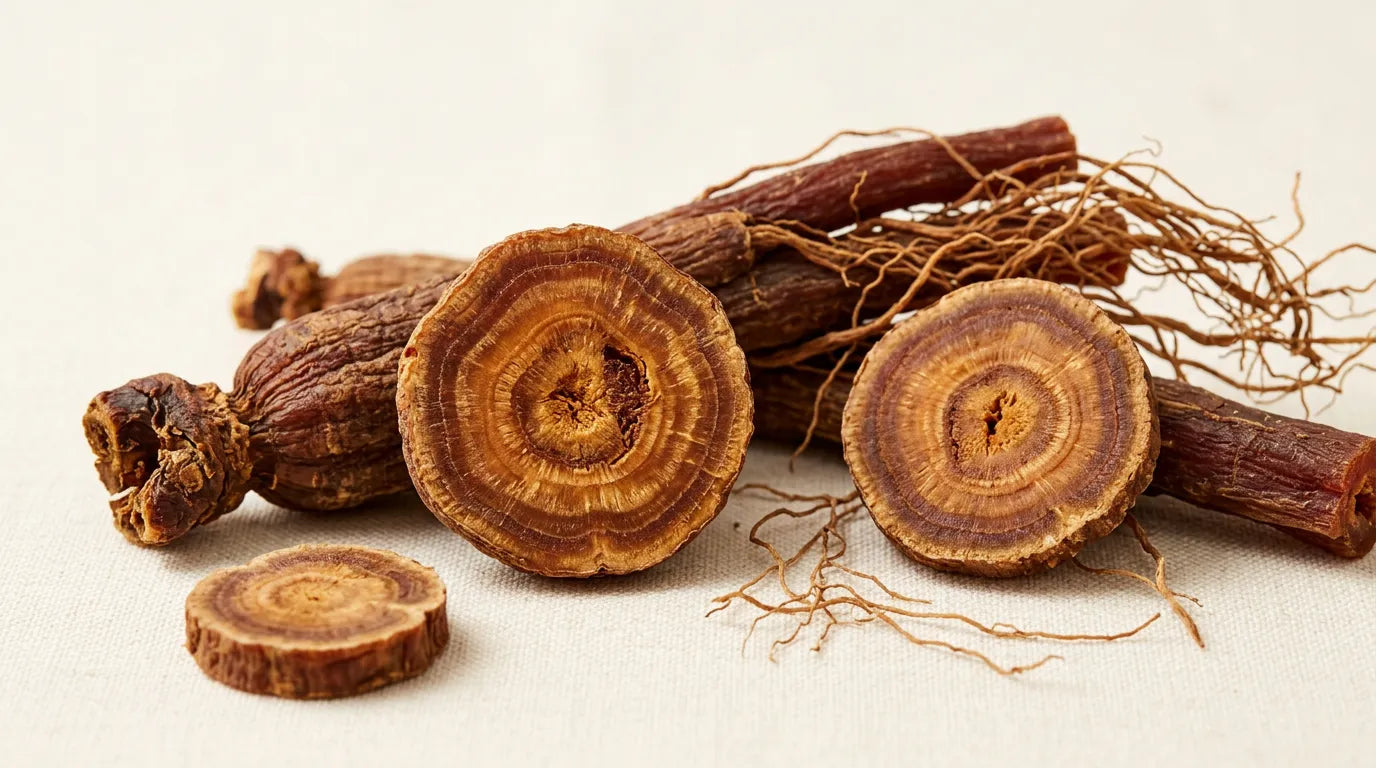
The "hidden half" — concentrated in the main body of the root. Polysaccharides, polyacetylenes, phenolic compounds, amino acids, and minerals.
Meet the hidden half
These are the compounds the label rarely mentions, but they're a real part of the story:
- Acidic polysaccharides. Often considered the headline non-saponin, discussed in research on immune balance. Notably, they're reported to increase by 60%+ during the steaming that turns fresh ginseng into red ginseng — so red ginseng carries far more than the fresh root.
- Polyacetylenes. A distinctive compound group studied in relation to cellular health. In comparative analyses, Korean red ginseng led the world's ginsengs in polyacetylene content.
- Phenolic compounds. Associated with antioxidant balance.
- Amino acids & minerals. The quiet contributors to the root's natural complexity and nutritional depth.
Source: Korean Society of Ginseng educational materials on saponin and non-saponin compounds. These describe areas of research, not guaranteed effects.
Why the body of the root matters
Here's a detail that ties back to how to read a label. Ginsenosides concentrate in the thin rootlets, while the prized polysaccharides sit in the main body of the root. That's why a sky-high saponin number isn't automatically "better" — a brand can chase that figure with rootlets while the body-based non-saponins quietly drop. A genuinely good red ginseng keeps both in balance.
One way to picture it: if ginsenosides are the engine oil — keeping things moving, energized, circulating — the non-saponins are more like the armor and balance system, associated with resilience and immune balance. The real strength of red ginseng isn't one compound. It's the full-spectrum synergy of the two together.
What "full spectrum" actually means
When we say Dr. Choi's is full spectrum, this is what we mean — not just a high ginsenoside number, but the complete profile of a 6-year root, steamed to raise the non-saponins, with both halves kept intact. An isolated compound or a saponin-only mindset misses the point of what red ginseng has always been: a whole, balanced botanical, not a single extracted molecule.
So next time you see a ginseng product defined entirely by one milligram number, remember you're only hearing the violins. The full orchestra is the point.
The whole root, not half of it
Dr. Choi's keeps the full spectrum intact — ginsenosides and non-saponins, from 6-year Geumsan roots, steamed the traditional way and lab-tested every batch.
Explore the ginseng →* These statements have not been evaluated by the Food and Drug Administration. This product is not intended to diagnose, treat, cure, or prevent any disease. The compounds described reflect published analyses and areas of ongoing research, not guaranteed effects, and individual responses vary. This article is for educational purposes and is not medical advice; if you are pregnant, nursing, taking medication, or managing a health condition, consult a qualified healthcare professional before starting any supplement.