
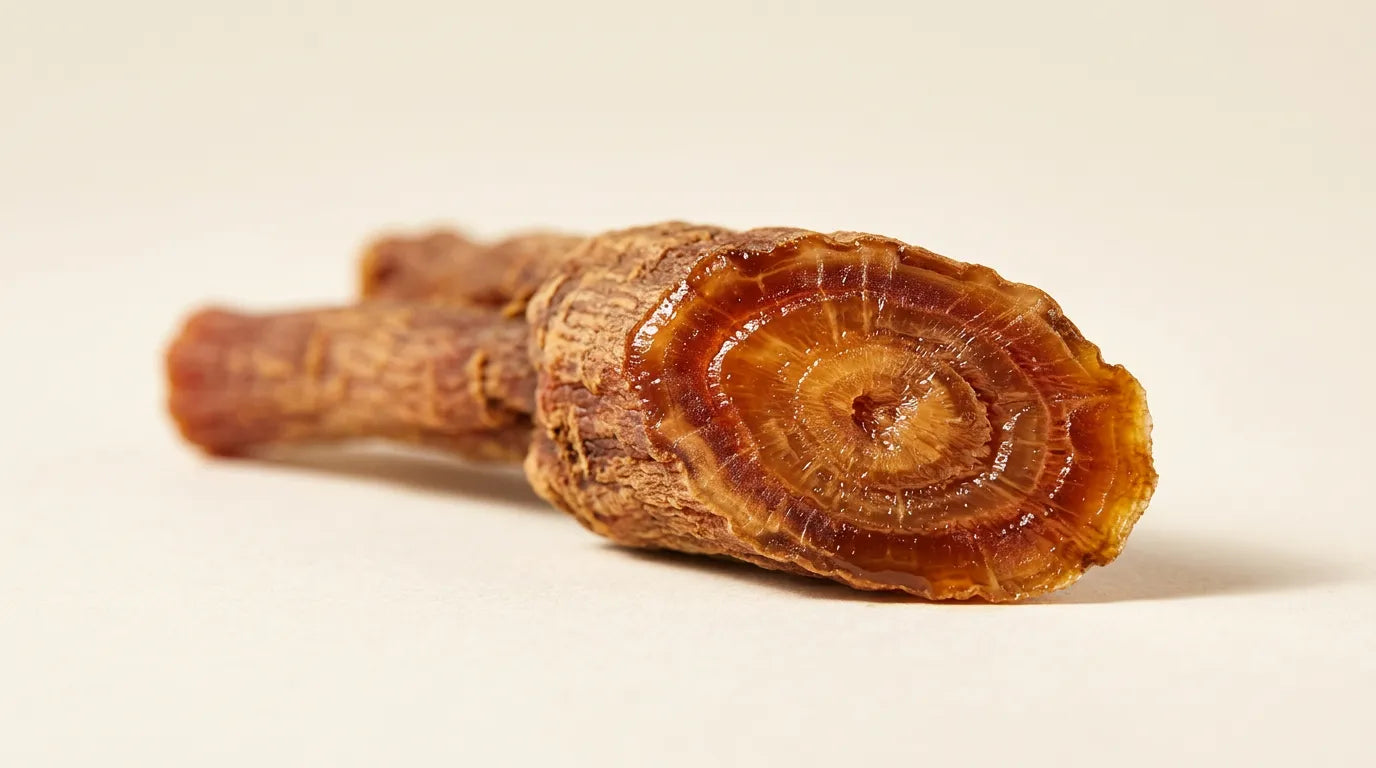

Look at almost any Korean red ginseng label and you'll see a number next to one word: ginsenosides. It's the figure brands compete on, the thing lab reports measure. But most people buy ginseng without ever being told what a ginsenoside actually is — or why it earned a name no other plant compound has. Here's the short, clear version.
A saponin with its own name
Start one level up. Ginsenosides belong to a broad family of plant compounds called saponins — natural substances found across many plants, known for foaming in water and for being biologically active. Soybeans have them. So do oats, quinoa, and countless herbs.
So why does ginseng's saponin get a special name? Because its structure is genuinely different. The sugar-chain architecture of ginseng saponins sets them apart from the saponins in other plants — different enough that scientists coined a dedicated term by joining two words: ginseng + glycoside = ginsenoside. The name itself is a small piece of evidence: these compounds were distinct enough to deserve their own category.
Why this matters for daily use: many ordinary plant saponins can irritate or even rupture red blood cells — which is part of why you don't eat most raw saponin-rich plants in quantity. Ginseng's saponins are structurally different and are recognized for being gentle enough for regular, long-term use. That's a big part of why ginseng, unlike many potent botanicals, has a 2,000-year history of being taken consistently rather than occasionally.
Not one compound — a whole family
Here's where it gets interesting. "Ginsenoside" isn't a single molecule. It's a family of dozens of related compounds, each labeled with a letter-and-number code — Rb1, Rg1, Re, Rg3, and many more. Researchers group them by their molecular backbone, and the different types are associated with different areas of wellness research.
A few of the most commonly discussed:
| Ginsenoside | Often discussed in relation to |
|---|---|
| Rb1 | Cognitive wellness, antioxidant support, daily vitality |
| Rg1 | Daily vitality, cognitive wellness, immune support |
| Re | Healthy circulation, antioxidant balance |
| Rg3 | Healthy circulation, antioxidant balance, cellular wellness research |
| Rh1 / Rh2 | Immune support and broader wellness balance |
Rg3 is worth a second look. It's one of the rarer ginsenosides, and it isn't simply present in the fresh root — it's largely created during the traditional steaming that turns fresh ginseng into red ginseng. Producing high-concentration Rg3 is difficult, which is exactly why it's treated as a marker of quality processing rather than a given. (We dug into the steaming step in a separate Journal piece.)
Why the range matters more than any single number
Because ginsenosides are a family, the more meaningful question isn't just "how much" — it's "how many types." A ginseng with a broad spread of ginsenosides offers a fuller, more complete profile than one carrying a narrow set at a high number. This is where Korean ginseng stands apart: it's associated with one of the most diverse ginsenoside profiles of any ginseng in the world, well ahead of common American or Chinese varieties in the number of types present.
And ginsenosides, remarkable as they are, aren't the whole story. Red ginseng also carries non-saponin compounds — acidic polysaccharides, polyacetylenes, phenolic compounds — that work alongside the ginsenosides. That combination is what "full-spectrum" really means, and it's the subject we explore on The Science page.
What to actually look for
So when you read a ginseng label, you now know what the number refers to: the concentration of these specially-named ginseng saponins. A higher number can signal a more substantial dose — but the fuller picture includes the diversity of types and the non-saponin compounds standing behind them. The most transparent brands go one step further and publish a Certificate of Analysis for each batch, so the number on the box isn't a claim — it's something you can verify.
See the number for yourself Dr. Choi's Korean Red Ginseng is made from 6-year Geumsan roots with the full spectrum preserved — and every batch is lab-tested, with a conservative ginsenoside figure printed on the box.
Explore the ginseng →* These statements have not been evaluated by the Food and Drug Administration. This product is not intended to diagnose, treat, cure, or prevent any disease. The compound associations described here reflect areas of ongoing research, not guaranteed effects, and individual responses vary. This article is for educational purposes and is not medical advice; if you are pregnant, nursing, taking medication, or managing a health condition, consult a qualified healthcare professional before starting any supplement.