
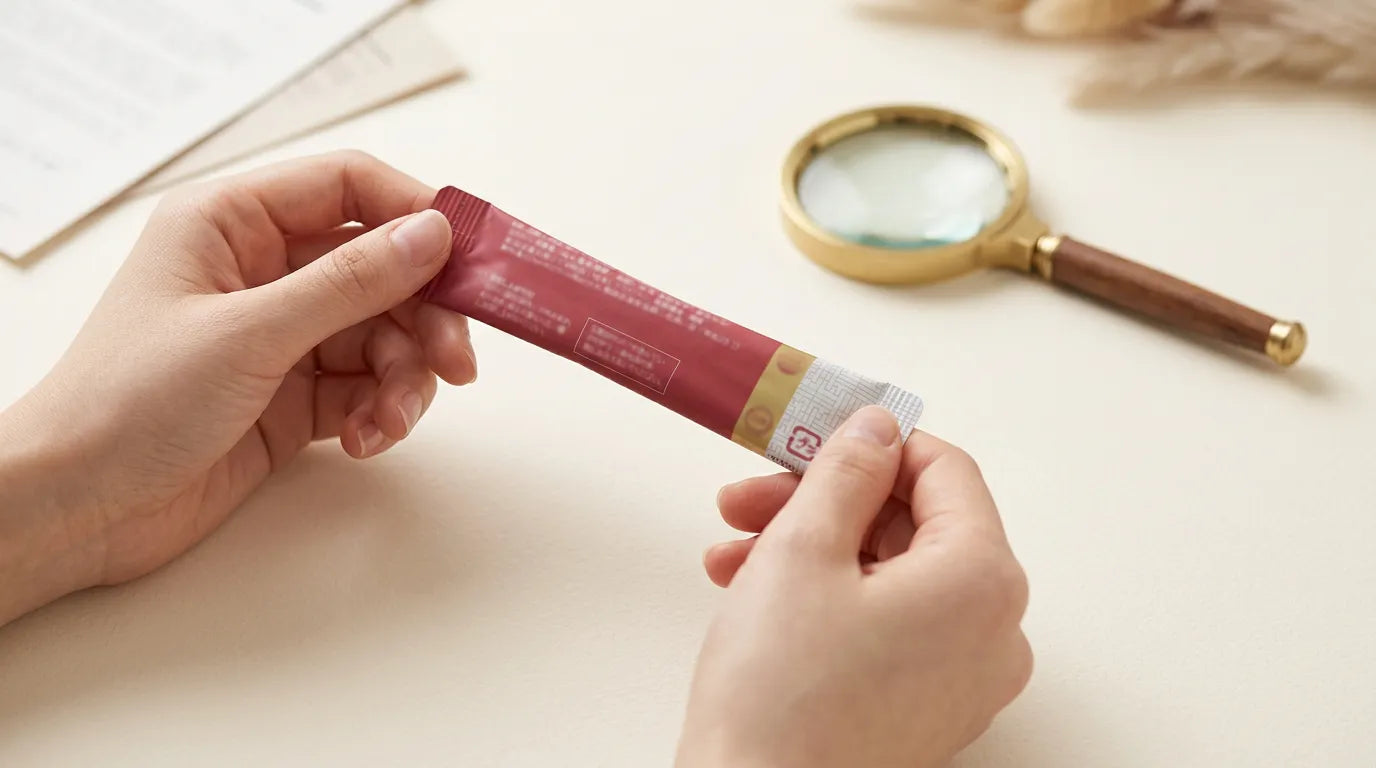

Two ginseng boxes can look almost identical — same "3,000 mg extract," similar price, similar promises — and contain genuinely different products. The label is where the truth hides, if you know which lines to actually read. Here's how to decode one in about two minutes.
The number that looks impressive but isn't the point
Most boxes lead with the extract amount — "3,000 mg of red ginseng concentrate." It sounds like a lot, and nearly every brand prints something similar, which is exactly why it doesn't tell you much. Extract weight is the size of the bucket. It says nothing about what's actually in it.
The number that matters more is the one many labels are quieter about: ginsenoside content — the active compounds we broke down here. That's the line worth hunting for.
Same "3,000 mg extract," roughly 2.6× the ginsenosides per stick.
The five lines worth reading
- Ginsenoside content (in mg). Not the extract weight — the active number. If a brand doesn't state it at all, ask why.
- Root age. 6-year roots are the mature standard, valued for fuller composition. "Korean ginseng" without an age tells you less.
- Origin. Where the root was grown matters. Geumsan, Korea is the traditional heartland for a reason.
- Red vs. fresh. "Red" means it was steamed — a process that builds rare compounds the fresh root doesn't have. We covered why steaming changes everything.
- Proof. Can the brand actually show you the numbers for your specific batch — or are you just trusting the print on the box?
The trap: don't be fooled by saponin content alone
Here's something even careful shoppers miss. A high saponin (ginsenoside) number isn't automatically better. Saponins concentrate in the fine rootlets and skin, so a maker can push that figure up simply by using more of those parts — while the valuable polysaccharides, which sit in the main body of the root, go down. As the Korean Society of Ginseng cautions, you shouldn't judge ginseng by saponin content alone; a well-balanced root matters more than one inflated number.
Source: Korean Society of Ginseng educational materials on selecting quality ginseng.
Which is the whole reason the fifth line — proof — is the most important one.
Why "show me" beats "trust me"
Anyone can print a number on a box. The real question is whether they'll back it. Here's how we handle it, and what to look for in anyone:
We print a conservative 30 mg minimum on the box — because every batch should clear it. The actual measured number is often higher. Rather than asking you to take that on faith, every lot has a Certificate of Analysis (COA) you can look up to see your batch's real numbers. Under-promise on the box, verify in the lab.
That's the difference between a marketing claim and a checkable fact. When you're paying premium prices, "we tested it and here's the document" should beat "trust the label" every time — whichever brand you choose.
Your two-minute label check
Next time you're holding a box: skip past the big extract number, find the ginsenoside content, check for root age and origin, confirm it's truly red (steamed), and — most of all — ask whether the brand can show you the proof for your batch. If it can't answer that last one, the rest is just print.
Numbers you can check Dr. Choi's prints a conservative 30 mg minimum — and gives you the per-batch COA to verify it. 6-year Geumsan roots, full spectrum, lab-tested every batch.
Explore the ginseng →* These statements have not been evaluated by the Food and Drug Administration. This product is not intended to diagnose, treat, cure, or prevent any disease. Ginsenoside figures refer to label and per-lot Certificate of Analysis values; actual measured content varies by batch. This article is for educational purposes and is not medical advice; if you are pregnant, nursing, taking medication, or managing a health condition, consult a qualified healthcare professional before starting any supplement.