
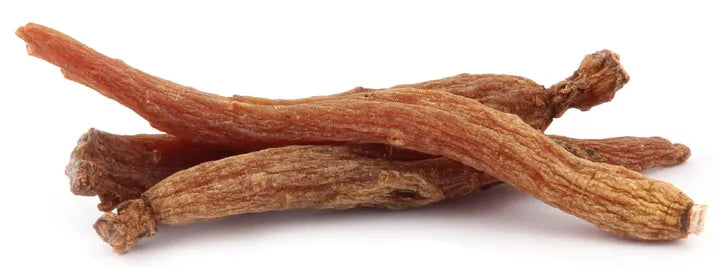

Walk down any supplement aisle right now and ashwagandha is everywhere. It has become shorthand for "the calm, anti-stress herb." Korean red ginseng rarely gets shelved next to it — and yet the two belong to the same small, serious family of botanicals: adaptogens. If you found ginseng while looking for an ashwagandha alternative, this is the comparison worth reading slowly.
First, what an adaptogen actually is
The word isn't marketing. It comes from research that began in the early 1950s, when scientists started looking for plants that help the body hold steady under physical and mental load. Israel Brekhman, one of the field's founding researchers, ran a now- famous study on naval cadets and found that those given ginseng performed measurably better under exertion. A colleague, Petkov, documented anti-stress effects. From this work came a specific idea: certain plants don't push one organ in one direction — they help the body's systems adapt where they're running low.
That property earned them a name: adaptogens. And of all the plants studied since, Korean ginseng is the one most often described as the original, defining adaptogen. Ashwagandha sits in the same category. So the honest question isn't "which is the adaptogen" — they both are. It's how they differ.
Where ashwagandha and red ginseng diverge
Ashwagandha (Withania somnifera) comes out of the Ayurvedic tradition and is most often reached for as a calming, evening-leaning herb. Korean red ginseng (Panax ginseng) comes out of two thousand years of East Asian use and is associated more with daytime vitality and sustained energy — without caffeine.
But the deeper difference is in what's actually inside. Ginseng's active story is unusually broad.
| Ashwagandha | Korean Red Ginseng | |
|---|---|---|
| Tradition | Ayurvedic (India) | 2,000+ years, East Asia |
| Typical association | Calming, evening | Daytime vitality, caffeine-free |
| Signature compounds | Withanolides | Ginsenosides + non-saponins |
| Compound breadth | Narrower | Full-spectrum (see below) |
The full-spectrum difference
Ginseng's signature compounds are called ginsenosides — a type of saponin so distinct to ginseng that it was given its own name. Here's the part most comparisons miss: Korean ginseng carries one of the most diverse ginsenoside profiles of any ginseng in the world. After the traditional steaming process that turns fresh ginseng into red ginseng, the number of ginsenoside types rises substantially — far more than is found in American or Chinese ginseng varieties.
A profile worth seeing: Korean red ginseng is associated with one of the widest ranges of ginsenoside types among the world's ginsengs — including rare ones like Rg3 that the steaming process helps create. Ashwagandha's profile centers on a different, narrower set of compounds called withanolides.
And ginsenosides are only half of it. Korean red ginseng also carries non-saponin compounds — acidic polysaccharides, polyacetylenes, phenolic compounds — that are often discussed in immune-related and antioxidant research. These rise notably during the red-ginseng steaming stage. When people say "full-spectrum," this is what they mean: the compounds work as a whole, not as a single isolated extract. We wrote more about that hidden half in the Journal, and the complete breakdown lives on The Science page.
So which should you reach for?
If your goal is purely winding down at night, ashwagandha is a reasonable, well-known choice. But if what you actually want is steady, caffeine-free vitality through the day — energy that doesn't spike and crash — Korean red ginseng is the adaptogen built around exactly that, with a fuller natural composition behind it. Many people aren't leaving ashwagandha because it failed; they're moving toward ginseng because they want the broader, daytime-leaning profile.
One more thing that sets quality ginseng apart: it has a two-thousand-year track record of being taken consistently, over long stretches, in traditions that classified it among the gentlest botanicals — the kind meant for the long term rather than the quick fix. That's a different relationship with a supplement than most people have with anything on the shelf.
Curious how it feels? Dr. Choi's Korean Red Ginseng is made by a pharmacist, from 6-year Geumsan roots, with the full spectrum kept intact — and every batch is lab-tested.
Explore the ginseng →* These statements have not been evaluated by the Food and Drug Administration. This product is not intended to diagnose, treat, cure, or prevent any disease. Adaptogen research is ongoing and individual responses vary. This article is for educational purposes and is not medical advice; if you are pregnant, nursing, taking medication, or managing a health condition, talk with a qualified healthcare professional before starting any supplement.